By Morgan Kainu — Applied Space Anthropologist & Mission Development Director, Space Nation
Understanding Anthropology: The Study of Humans
Before we can understand space anthropology, it helps us to know what anthropology itself is.
Anthropology is the study of humans. I liked to compare us to being the “experts of our species”. It explores who we are, where we come from, how we live, and how we make meaning in the world and our place within it. Anthropology examines the full spectrum of the human experience, encompassing our biological evolution, environment, social systems, languages, beliefs, and daily behaviors.
Anthropology has four traditional branches:
- Cultural Anthropology
Explores how people create and share meaning through culture, customs, and everyday life. - Physical (or Biological) Anthropology
Studies the evolution and physiology of humans and our relatives. - Archaeology
Explores and studies human history through material remains and artifacts. - Linguistic Anthropology
Examines and studies how language shapes thought, identity, and culture.
Applied anthropology, the branch I work in, takes each of these branches and applies them to real-world problems. This can range from healthcare, technology design, to policy, sustainability, space exploration, and beyond.
Applied Anthropology encourages us to ask questions such as: How can understanding human culture and behavior help us solve complex real-world problems? For example, one of my first projects involved collaborating with the National Association for the Practice of Anthropology (NAPA) to understand how practicing anthropologists utilized the website, allowing us to identify common themes that informed User Experience (UX)/design changes.
Applied anthropologists often work beyond academia within organizations, industries, or field environments, translating human insights, patterns, and data into systems, tools, procedures, and/or protocols.
For my research, I utilize ethnographic field methods to help collect these important data and document patterns.
Ethnography is the study of people in their real-world, or lived, environments. Rather than relying primarily on surveys or lab settings, ethnographers observe, participate in, and document daily life to understand how people experience their day-to-day routines and make decisions.
Ethnographic methods can include:
- Participant Observation
Being present within the environment being studied, as a quiet observer. - Fieldnotes and Interviews
Capturing lived experiences and conversations in real time. - Pattern Recognition
Identifying recurring themes, rituals, or interactions that reveal cultural or behavioral dynamics. - Interpretation and Application
Turning observations into insights that can guide design, policy, or organizational change.
Ethnography allows us to understand how people live, work, and connect. For applied anthropologists, it’s a way to bridge human experience with systems improvement, ensuring that progress, whether social or technological, remains grounded in the human experience.
Introducing Space Anthropology
Historically, anthropology has helped us understand our time here on Earth. Space anthropology extends that understanding beyond our terrestrial home.
Space anthropology is a still-emerging subfield of anthropology with a focus on what it means to be human, not just within our familiar cultural or social terms here on Earth, but in the contexts of exploration, technology, and adaptation to extreme environments both on and off-planet.
It examines how humans live, work, and make meaning in places where humans aren’t typically meant to endure. Spacecraft and analog environments that simulate life on the Moon, Mars, and beyond are the exact austere environments where human resiliency and adaptation are put to the test. Some space anthropologists focus on the human systems of communication, trust, rituals, belonging, and subtle emotional and cultural dynamics.
My ethnographic work at MICO-VIE (Mission Coordination Center, Vienna) explores these intersections. I study how people coordinate across vast distances, how trust is built under pressure, and how culture quietly takes shape in an environment designed for precision and performance.
By observing and documenting these patterns, I aim to understand not just how missions operate, but how they feel. How do humans hold complexity together as we prepare to become a multiplanetary species?
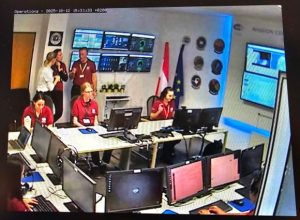 Photo Credit: Morgan Kainu, MICO-VIE Mission Coordination Center during the WBA simulation
Introduction: A Historic Moment for Human Space Simulation
After a little more than 3.5 years of preparation, an extraordinary moment unfolded in Vienna. In a room lined with monitors, headsets, flags from across the world, and live communication channels connecting continents, a unique space analog mission began.
MICO-VIE (Mission Coordination Center, Vienna) served as the central hub for the World’s Biggest Analog (WBA), a global, multi-site space simulation connecting 17 (seventeen) analog habitats across 5 (five) countries. Together, these habitats, along with MICO-VIE and research teams, formed a global simulation to explore how we might live and work beyond Earth.
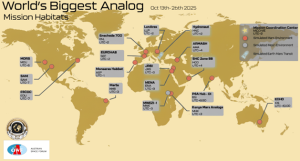 Photo Credit: World’s Biggest Analog
Diplomats from multiple countries, the MICO-VIE team, and participating analog astronauts joined in the moment of “polling” (“go”/”no go”), which was hosted LIVE on YouTube. While the excitement of initiating the mission was emotional and at the forefront, beneath the surface of logistics and live feeds, another story was unfolding. One about people, culture, and the unseen threads that hold highly logistical missions together.
That’s where my work begins.
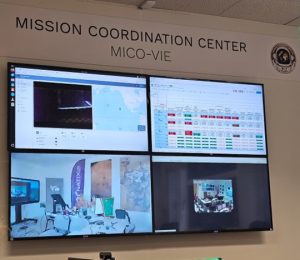 Photo Credit: Morgan Kainu, MICO-VIE live operations dashboard
The Human Side of Mission Control
As an applied space anthropologist, my role isn’t to design the mission’s systems. It’s to understand the people behind them.
While the teams at MICO-VIE focused on operations, logistics, and communications, I focused on what happens between those actions. My role is to quietly observe, document, and trace the human side of mission control.
Some of the questions shaping my focus are:
- How does mission coordination feel from the inside: the handovers, the jokes between shifts, the unspoken cues, the ways trust is built in real-time?
- How do people coordinate under pressure across languages, time zones, and cultural assumptions? What invisible rituals make a mission of this scale work?
- And how can we preserve these lessons as we prepare for future off-planet and multi-planet missions?
My ethnographic work at MICO-VIE aims to capture these human patterns in real-time.
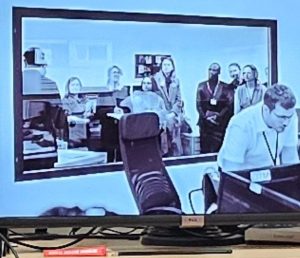 Researchers and Diplomats from participating countries observing MICO-VIE operations at the start of “polling”
A Living Record of Belonging
This ethnographic study, working title “An Ethnographic Analysis of the Emergence of a Centralized, Multi-Sited Mission Support Center during the World’s Biggest Analog Mission”, seeks to document the emergence of new cultural infrastructures in mission control environments.
Co-lead Brenda Trinidad and I call it a living record, or a “time capsule”, that captures the emotional and social dynamics of mission coordination.
What makes a mission succeed often can’t be captured by telemetry or technical logs. It lives in the shared jokes, crisis routines, improvised communication styles, and evolving trust among multicultural, international teams. These are some of the cultural foundations that make coordination possible but are often neglected in technical reports.
In this project, we’re interested not only in how things worked or didn’t work but also in how they felt. How is the sense of ‘belonging’ built and maintained across vast distances?
Each habitat participating in the WBA can be thought of as its own “world.” MICO-VIE serves as both the anchor and connective tissue — a symbolic and operational link between them.
In exploring how people create a sense of belonging within these distributed, high-stress systems, we’re learning lessons that extend beyond just space. 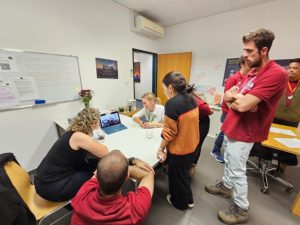 Photo Credit: Morgan Kainu, MICO-VIE sharing videos during BINGO social night
From Earth to Space: Why This Matters
As we move toward a future where Moon bases, Mars habitats, and orbital stations will need to operate autonomously yet interdependently, the evolution of mission control centers and how they operate to oversee multiple locations will help shape how humanity operates and expands into space.
Traditional mission control centers, such as those operated by NASA or ESA, can be hierarchical and procedural. Future missions may require distributed, multicultural, and international teams that communicate in real-time across vast distances (both on- and off-planet).
The MICO-VIE experiment provides us with a glimpse into that future. It’s a test not only of systems but of human adaptability.
How do we maintain situational awareness when time delays or cultural differences could fracture understanding? How can leadership, empathy, and communication scale across planets?
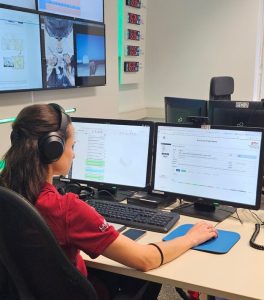 Photo Credit: Morgan Kainu, close-up of communications system between MICO-VIE, analog crews, and researcher utilizing the GMV communication tool
From Research to Storytelling
One of the most unique aspects of the WBA ethnographic work is its direct support for the Future Fiction Project (FFP). Future Fiction is an emerging form of speculative storytelling based on real ethnographic data. This is where my partner, Brenda Trinidad, with her Future Fiction work, steps in.
In parallel and as a supplement to my ethnographic work, Brenda and I are developing a narrative series inspired by MICO-VIE’s lived experiences — stories that ask not only what is, but what could be rehearsed.
This storytelling dimension transforms field data into accessible narratives that invite the public, scientists, artists, and dreamers alike to reflect on the cultural futures we’re already shaping.
These stories become both archives and blueprints, or cultural documents that preserve the spirit of this moment for those who will one day look back on how we began building multi-planetary societies.
The Broader Vision: Building Human-Centered Space Futures
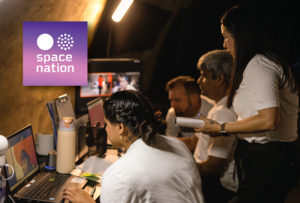
Photo Credit: Albert Lin, Space Nation simulation training in Midland, Texas
The MICO-VIE project is part of a larger vision of globally inclusive and human-centered exploration.
In my broader work with Space Nation, I focus on bridging anthropology, technology, and business development to design sustainable, psychologically resilient space missions. My approach is deeply interdisciplinary, combining science, storytelling, and the human experience.
Before joining Space Nation, I served as an Operations Coordinator at Radian Aerospace, where I supported the development of processes and high-visibility projects focused on human-centered aerospace innovation. Those experiences grounded my understanding of how systems and people intertwine. These lessons now guide my work on mission design, training, and space simulation research.
I’m particularly interested in how space exploration intersects with culture, collaboration, and global development and localization efforts. The future of space won’t belong to any one country or company. It will depend on our ability to adapt technology and training to diverse cultural contexts and capabilities.
By studying how people work together in simulation, we’re laying the foundation for how we will thrive together in space.
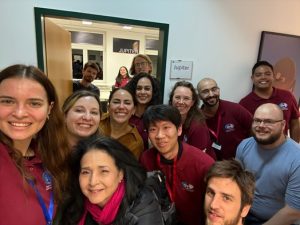 Photo Credit: Anja Klosterhuber, MICO-VIE Team members shortly after the official closing of the
World’s Biggest Analog, 2025
Beyond the Short Term
At its core, this research is about belonging. Not just to a mission or organization, but to the shared human endeavor of exploration.
As I write this, the sounds of MICO-VIE still echo deeply in my mind. The early morning pots of coffee, walking over to the next room for the team morning meeting as the “song of the day” blasts through the hall from a JBL speaker, the Spotify music “Daylist” of the day in the Remote Science Support (RSS) room, selecting a sticker to indicate “how we feel” for the day, the “popcorn” check-ins from Human Factors, all continue to permeate through me. These are just some of the textures of human endurance, creativity, and care that I experienced firsthand during my time with the teams at MICO-VIE during the WBA as an applied space anthropologist.
In documenting them, I hope to honor the people behind the systems and help shape a future where our expansion beyond our Earthly confines remains deeply connected to what makes us human.
Further Reading & Media
- Space Nation — Train Like an Astronaut | Space Nation Mission Simulations
- World’s Biggest Analog (WBA): The World’s Biggest Analog™
- Future Fiction Series (coming soon)
About the Author
Morgan Kainu is an applied space anthropologist specializing in the intersection of human culture, behavior, and operational systems in extreme environments. Her research examines how social and psychological dynamics shape space mission design and analog astronaut training. She serves as Mission Development Director at Space Nation, leads ethnographic research project for MICO-Vienna during the WBA, and has previously supported aerospace operations at Radian Aerospace.
Morgan’s work bridges science, culture, and storytelling, contributing to the advancement of sustainable, inclusive, and human-centered space exploration.